

Python Cubs is your new home for easy, enjoyable, and beginner-friendly way to learn python programming language!
You’re at the right spot whether you’re an adult out here to learn for the first time, a child just starting out, or a parent supporting your child’s education.
We’re starting your adventure today with the most crucial question of all:
What is it exactly, and why is it so popular?
Let’s investigate. and I assure you that this will be simple, amiable, and genuinely enjoyable. ❤️
1. What Is Python?
It is a programming language, which is a unique method of instructing a machine to perform tasks on your behalf.
It is used to communicate with computers, just as English is used to communicate with people. It allows you to make:
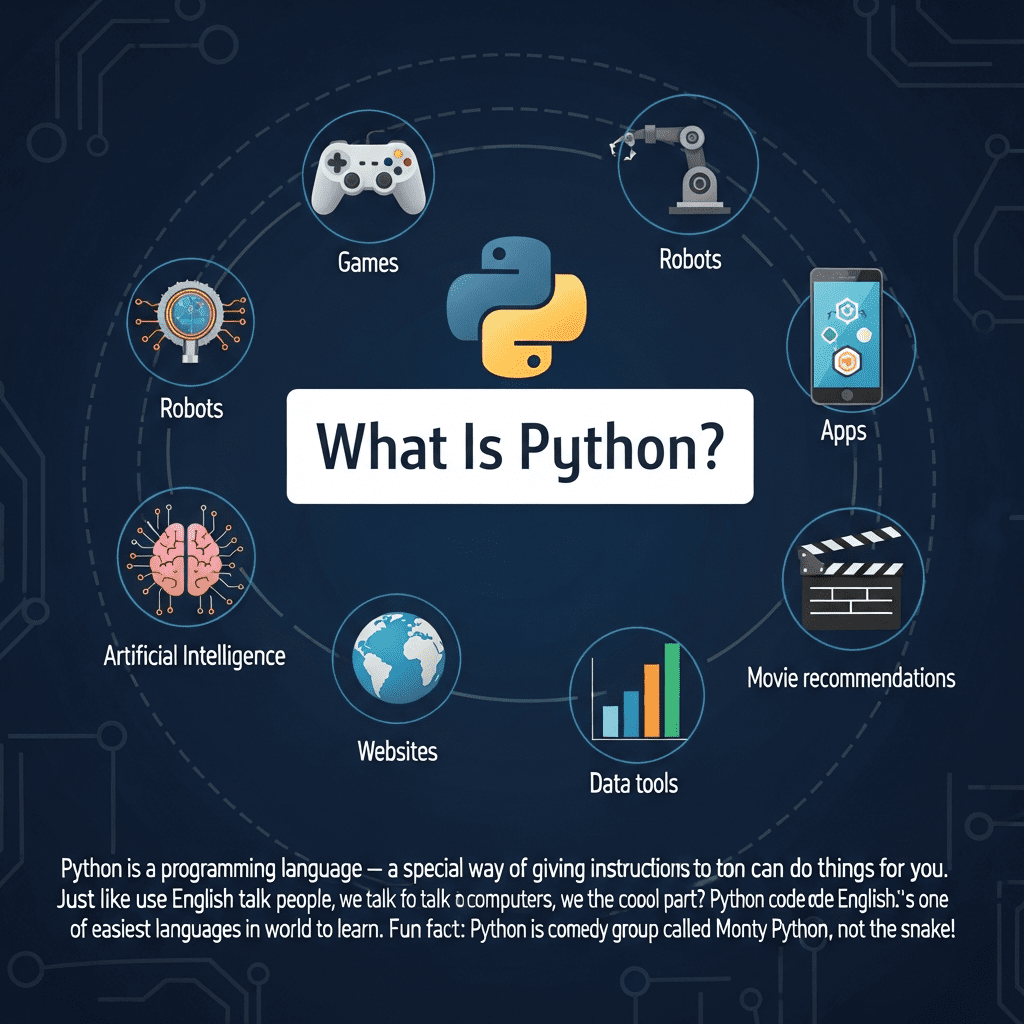
- 🎮 Games
- 🤖 Robots
- 📱 Apps
- 🌐 Websites
- 🧠 Artificial intelligence
- 📊 Data-driven tools
- 🎬 Movie suggestions (Yes, similar to Netflix!)
2. What Makes It So Well-Liked?
Millions of people—beginners, experts, scientists, NASA engineers, AI developers, and children—love Python!
This is the reason:
- It’s quite simple to read.
- Python comes naturally to anyone who has never coded.
- It requires fewer lines.
- With extremely brief programs, you can accomplish great things.
- It’s quite adaptable.
- Data, AI, Automation, Games? Python is capable of doing it.
- The community is really supportive.
- Millions of students equals a ton of assistance.
- It’s totally free.
- Python is free to download and use indefinitely.
Python preserves the joy while eliminating the stress. It’s the best language for beginners because of this.
3. In Real Life, Where Is Python Used?
Even if you weren’t aware of it, Python is used on a daily basis!
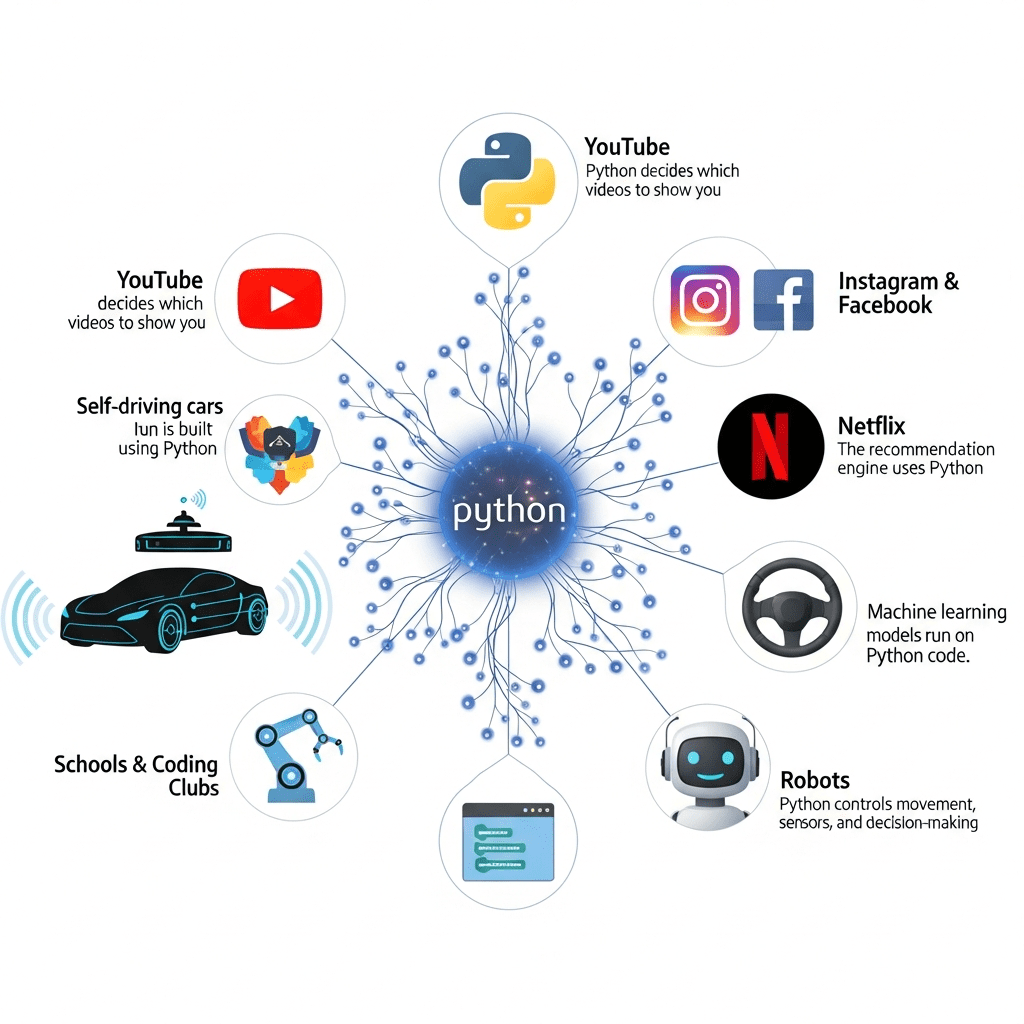
- YouTube
Python chooses which videos to display to you.
- Facebook & Instagram
Python is used extensively in the app’s construction.
- Netflix
Python is used by the recommendation engine.
- Autonomous vehicles
Python programming powers machine learning models.
- Robots
Movement, sensing, and decision-making are all managed by Python.
- Schools and Coding Clubs
The most popular language taught to children is Python.
Gaining knowledge of Python opens doors to the future.
4. The Reasons It Is Ideal for Novices (Especially Children!)
Python is approachable, serene, supportive, and not overpowering.
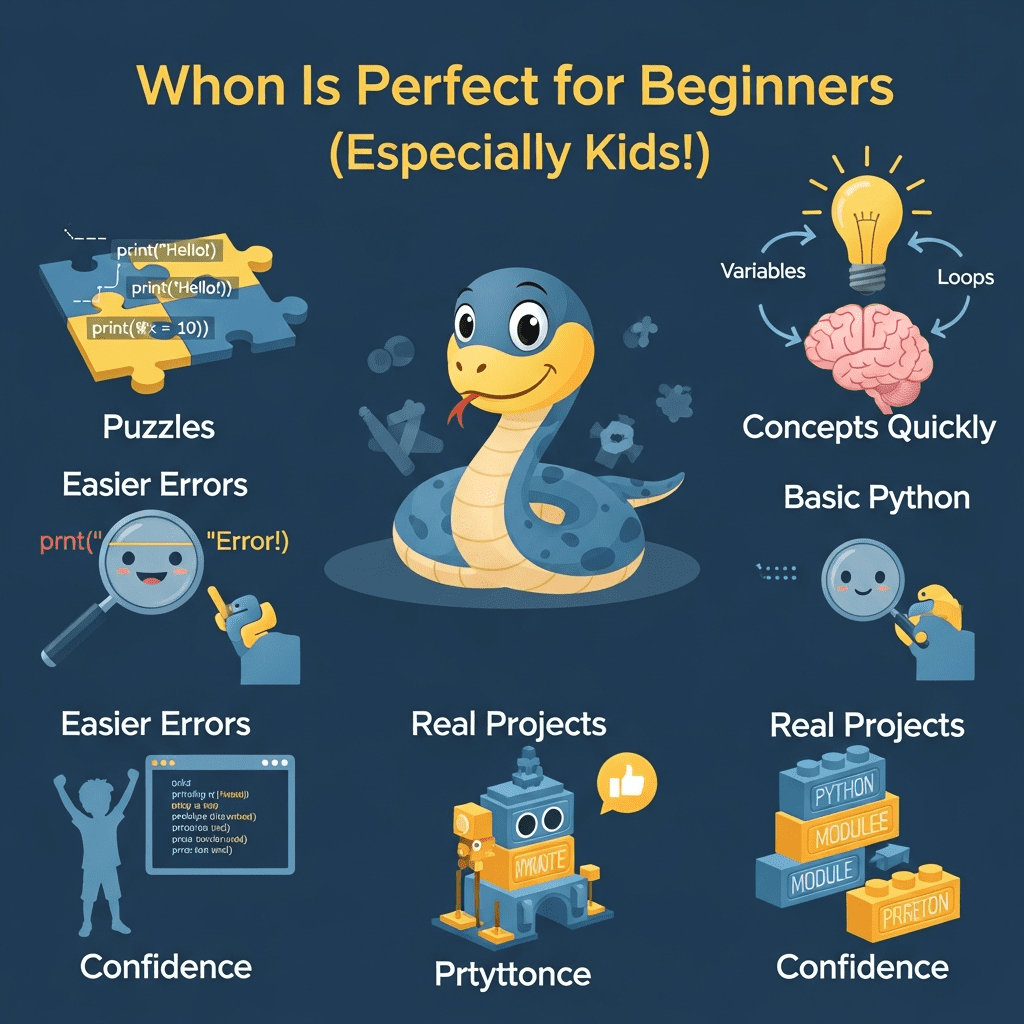
Here’s why novices love it:
- 🧩 The code is similar to solving easy puzzles.
- 🧠 You grasp ideas fast.
- 🔍 Errors are simpler to correct
- 🏗 You can start working on actual projects
- 🚀 It boosts new students’ self-confidence.
- 🎨 It facilitates creative coding for games, storytelling, and animations!
Learning Python is like learning to ride a bicycle—with useful training wheels.
5. The Workings of Python (Explained Like You’re Ten)
Alright, let’s say you have a robot pal.
You wish to convey a straightforward message to the robot:
“Robot, say hello.”
Thus, you write in Python:
print ("Hello")Your instruction is read by it.
And just like that, the robot follows your instructions flawlessly.
Coding is just that!
Programming is the act of providing precise instructions.
Computers don’t make guesses.
They don’t make assumptions.
They follow your instructions exactly.
Additionally, it makes communicating with computers shockingly simple.
6. Your Initial Python Application
Are you prepared to write your first command in Python?
Come on! 🎉
Your first line of code is as follows:
print ("Welcome to Python Cubs!")Python is instructed to show the message in quotations using this instruction.
When you execute it, you’ll observe:
Welcome to Python Cubs!Indeed, you just created an actual Python program!
This small moment marks the beginning of something enormous.
7. Key Python Terms (Easily Explained)
These are really easy, so don’t worry!
🔹 Program
a set of instructions.
🔹 Code
the text that you really write.
🔹 Variable
A small container for storing data.
For instance:
name = “Aisha”
🔹 Function
A recipe-like instruction that can be reused.
🔹 Loop
a method for automatically repeating actions.
🔹 Condition (if)
“If this happens, do that” is a decision.
These words will recur frequently, and you are already familiar with them!
8. Mini Practice Tasks (Do These!)
Let’s practice a little.
Open any Python editor (online or installed) and try these.
📝 Task 1: Print Your Name
print("My name is ______.")📝 Task 2: Print Your Favorite Food
print("I love ______.")📝 Task 3: Make Python Say Hello 3 Times
print("Hello")
print("Hello")
print("Hello")
📝 Task 4: Create a Secret Message
print("This is my secret message!")📝 Bonus Fun Task
Print your favorite cartoon character:
print("Shinchan is awesome!")You did it—you’ve already typed more Python than many beginners ever do on Day 1!
9. Summary of What You Learned
Today, you discovered:
- What Python is
- Why it’s so powerful
- How real companies use it
- Why it’s perfect for beginners
- How Python works
- Your first piece of code
- Key beginner terms
- Fun practice tasks
You’ve taken your first big step into the world of learning Python—and I’m seriously excited for your journey ahead.
10. Your Next Step: Install Python (Beginner-Friendly Guide)
Now that you know what it is, it’s time to install it on your computer and start coding for real.
Click here to continue →
✓ Learn How to Install Python on Windows, Mac, or Linux